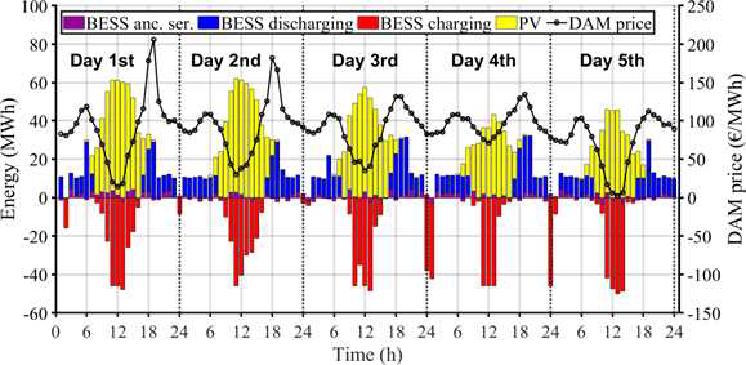
The increasing deployment of renewable energy sources has created a growing need for flexible resources capable of supporting power system operation. Battery energy storage systems (BESS) are increasingly deployed together with photovoltaic (PV) plants to enhance system flexibility and improve project economics. Hybrid PV-BESS systems can generate revenues from multiple market streams, including electricity price arbitrage and participation in ancillary service markets. This paper investigates the optimal sizing of battery storage in hybrid PV-BESS systems considering participation in both energy markets and ancillary service markets.
A techno-economic optimization model is developed to maximize the net present value (NPV) of the project while accounting for PV generation, battery operational constraints, ancillary service provision, and grid export limits. The model evaluates multiple combinations of PV and battery capacities using a grid-search approach.
The results indicate that the economic value of battery storage in the analysed case study is primarily driven by ancillary service capacity payments, while revenues from energy arbitrage play a relatively minor role. The analysis further demonstrates that the optimal battery capacity is strongly influenced by the size of the ancillary service market. When the available ancillary service capacity increases, the economically optimal battery capacity increases accordingly. These findings highlight the importance of considering ancillary service market constraints when designing hybrid PV-BESS systems and provide useful insights for developers and investors evaluating storage deployment in renewable energy projects.