Goal
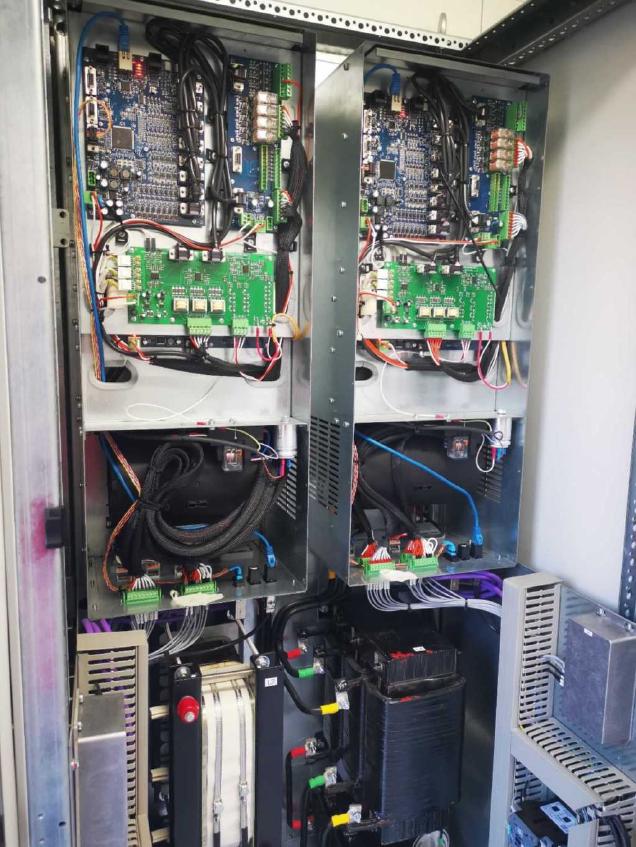
The objective of this work package is to develop and validate a hybrid power converter prototype designed for the integration and management of multiple distributed energy resources. The work will focus on the design, modelling, implementation, and experimental testing of a hybrid power converter with a nominal power of 100 kVA. The developed prototype will integrate several power conversion interfaces, including a grid-connected AC/DC converter, a battery DC/DC converter, a photovoltaic DC/DC converter, and an interface for wind energy conversion systems. The goal is to enable efficient energy exchange between renewable energy sources, battery storage systems, the electrical grid, and electric vehicles, including support for Vehicle-to-Grid (V2G) operation. By developing and experimentally validating this hybrid converter platform, the project aims to provide a flexible and scalable hardware solution capable of supporting advanced energy management strategies and integration of distributed energy resources within modern smart grids and microgrids.
Methods
To achieve this objective, the project will combine simulation-based design, control algorithm development, and experimental validation using a physical prototype. First, a detailed simulation model of the hybrid power converter will be developed and tested using software tools such as MATLAB and PLECS. The model will represent the electrical behavior and interaction of the converter components, including the grid interface, battery storage interface, and renewable energy interfaces. Simulation studies will be used to analyze system dynamics, verify converter operation, and support the development of control strategies. Second, a 100 kVA prototype of the hybrid converter will be implemented and basic control algorithms will be developed and tested. The prototype will include a grid-connected AC/DC converter, a battery DC/DC converter, and a photovoltaic DC/DC converter, enabling coordinated operation of multiple energy sources and storage systems. Finally, the control algorithms will be further optimized to improve converter performance, efficiency, and stability under different operating conditions. Special attention will be given to algorithms enabling bidirectional power flow and integration with Vehicle-to-Grid (V2G) systems, allowing the converter to support advanced energy management and grid support functionalities.